1



Menu
🌼 Sarva Pirtu Shradh 🌼
॥ ॐ श्री परमात्मने नमः ॥
🚩 Sarva Pirtu Shradh 2025 🚩
About Pirtu Shradh
There is an old saying- “We reap what we sow”. Hindus believe that what we do in life affects our future, and this also applies to our ancestors. If our ancestors did bad things in their lives, their karma may be passed on to us. But by performing Shradh or Pitru Paksha rituals, we can help to prevent this from happening. These rituals also help to calm our ancestors’ souls and make them happy.
Each year during the Bhadrapada month, which falls around August-September as per the Gregorian calendar, Hindus remember their ancestors and make offerings (usually in the form of food) by observing shraddh during the 16-day period known as Pitru Paksha. The period extends from Purnima to Amavasya during the month. Shraddh or tarpan is performed during this period, irrespective of whether the ancestors passed away during Krishna Paksha or Shukla Paksha. It is believed that deceased ancestors visit their descendants during this period.
The term ‘Sarva Pitru’ denotes ‘all forefathers or ancestors’ and Sarva Pitru Amavasya is dedicated to all ancestors whose death tithi may have been forgotten or is unknown. In Bengal, the day is observed as ‘Mahalaya,’ signifying the beginning of the celebration of Durga Puja or Navratri festivities. The day is therefore also known as Mahalaya Amavasya or Sarva Pitra Moksha Amavasya. While it is observed in Bhadrapada month as per Hindu calendar in South India, it is observed during Ashwin month in North India.
***
🕰️Amavasya Shraddha 2025 Date & Time:📅
Amavasya Shraddha – Sunday, September 21, 2025
Kutup (कुतुप) Muhurat – 12:07 PM to 12:56 PM
Duration – 00 Hours 49 Mins
Rohina (रौहिण) Muhurat – 12:56 PM to 01:44 PM
Duration – 00 Hours 49 Mins
Aparahna (अपराह्न) Kaal – 01:44 PM to 04:10 PM
Duration – 02 Hours 26 Mins
Amavasya Tithi Begins – 12:16 AM on Sep 21, 2025
Amavasya Tithi Ends – 01:23 AM on Sep 22, 2025
***
💐 Pitru Paksha or Shradh Meaning 💐
In Sanskrit, the words “Pitru” and “Paksha” denote the predecessors or forefathers and the time, respectively. Every year around this time, individuals make food gifts to their ancestors. It is one of the most significant times in Hinduism.
People think that honouring our ancestors or progenitors will result in divine favours. Invoking the divine’s favour is a lucky thing to do since Pitru paksha shradh appeases the Hindu God. The primary goal of this rite, however, is to ask God to pardon the ancestors’ previous transgressions or crimes.
***
🍀Significance of Pitru Paksha:🍀
In Hinduism, Pitru Paksha, also known as Shradh, has long held great significance. Let’s elaborate on this subject below.
- To ensure that our ancestors enter paradise and unite with God, shradh is performed.
- Tarpan, or Shradh ceremonies, bring comfort to the departed souls.
- The ancestors are thought to come to Earth during Pitru Paksha. That is why all of the actions are carried out in an effort to calm their souls and win their blessings.
- Pitrilok is the name of a world that is thought to be situated halfway between Earth and heaven. Three generations of ancestors live in this location.
- One of the three ancestors leaves a place in heaven for the deceased soul when someone from the next generation passes away.
- The Pitrilok are under the care of Lord Yama, the God of Death. Thus, the Shradh rituals are an opportunity to also make an impression on him.
- Happiness in the ancestors’ rebirth is ensured by doing Pitru Paksha.
- In addition, Pitru Paksh or Shradh is a significant period of time for those who have Pitra Dosh in their horoscope.
***
🌻 Pitra Dosh in a horoscope🌻
It is important for everyone with Pitra Dosh in their horoscope to be aware of this. Pitra Dosh is a karma debt owed by our ancestors that is said to have a detrimental effect on the following generation. The current generation’s life is expected to be affected by these issues and obstacles. Even the planets are dislocated from their appropriate homes during this period.
***
🍀 Remedies for Pitra Dosh:🍀
Pitru Dosh may be a problem and needs to be removed as a result. In addition to doing Shradh, the following are some methods for eradicating Pitru Dish:
- Give food to the hungry, including dogs, birds, and the impoverished.
- Spend time with seniors and show them respect.
- Make a donation, especially around the New Moon or Amavasya, to hospitals or to those with physical disabilities. The auspiciousness would also be increased by burning a lamp and providing food for the Brahmins.
- Water the Banyan tree and give the cow some food.
- Respect your husband or wife.
***
💐 Pitru Paksha Rituals 💐
- Amavasya Shradh ceremonies and tarpan are carried out for ancestors whose shradh could not be carried out on the scheduled tithi on Sarva Pitru Amavasya. On this day, some people even do shradh for all of their ancestors at once.
- Given that the Amavasya Pitru Paksha starts the day following Purnima, the day is also designated for the shraddh of individuals who passed away on “Purnima,” “Amavasya,” or “Chaturdashi.”
- On Sarva Pitru Amavasya, People in yellow clothing ask Brahmins to donate money and food and offer food.
- The oldest male relative performs the Amavasya Shradh ceremony most frequently.
- The observers must wash the Brahmins’ feet and seat them in a revered location. Additionally, sesame seeds are scattered near where the Brahmins are seated.
- On Sarva Pitru Amavasya, people offer flowers, Diya, and dhoop as prayers to their ancestors. There is also a grain and water concoction available.
- Brahmins are provided with special meals once the puja rites have been completed.
- Mantras are continuously recited to evoke the blessings of the ancestors.
***
🙏 Amavasya Pitru Pooja Vidhi 🙏
- The Amavasya Pitru Pooja is performed during the Pitru Moksha Amavasya. So to find out how to perform the Amavasya Pitra Puja on Mahalaya Amavasya, read on!
- Hinduism holds that in order to live a life devoid of suffering, a person must pay back three different kinds of Rinas, or debts. Three Rinas—Deva Rina, Rishi Rina, and Pithru Rina—owe debts to God, the guru, and the ancestors, respectively.
- The son is obligated to assist his parents both while they are alive and after they have passed away by completing the Shradh to free the souls of the deceased, according to ancient beliefs. The significance of these rites is mentioned in the Garuda Purana, Vayu Purana, Agni Purana, Matsya Purana, and Markandeya Purana.
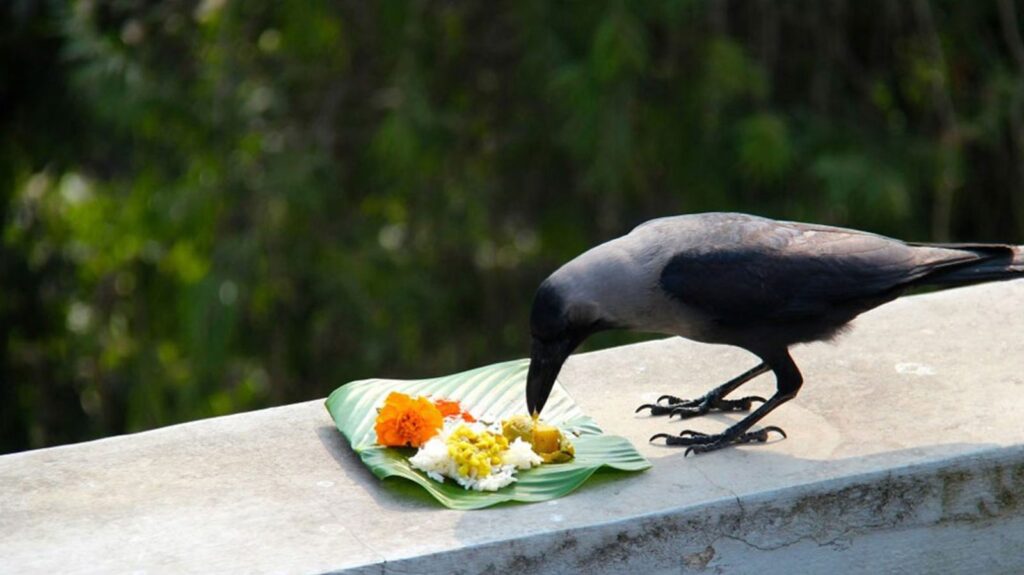
- To present one-of-a-kind offerings to the Mahalaya Amavasya pooja’s departed, tharpana is used. Uncooked rice and black sesame seeds are combined with water to make tarpana, which is then prepared by calling on the ancestors and their nakshatra. Men who have lost their fathers carry out this ritual. With the understanding that our ancestors appear in many forms and partake in the offerings, animals, and birds like the crow are permitted access to the food offerings.
***
🍀Mantras of Pitra Dosh Nivaran Mantra:🍀
ॐ श्री पितृदेवाय नमः।
Om Shri Pitridevay Namah.
ॐ श्री पितृभ्य: नम:।
Om Shri Pitribhya: Namah.
ॐ श्री सर्व पितृ देवताभ्यो नमो नमः।
Om Shri Sarva Pitru Devtabhayo Namo Namah.
ॐ पितृभ्यः स्वधायिभ्यः पितृगणाय च नमः।
Om Pitribhyah Swadhayibhyah Pitrganaya Cha Namah.
ॐ श्राध्दाय स्वधा नमः।
Om Shraddhaya Swadha Namah.
ॐ नमः शिवाय ।
Om Namah Shivay.
Pitru Gayatri Mantra
देवताभ्यः पितृभ्यश्च महा योगिभ्य एव च ।
नमः स्वाहायै स्वधायै नित्यमेव नमो नमः ।।
Devtabhyah pitribhyascha maha yogibhya eva ch.
Namah Swahaayai Swadhaayai Nityameva Namo Namah.
***
💐Conclusion 💐
Sarva Pitru Amavasya is a day to remember, honor, and connect with our ancestors, emphasizing the significance of family, ancestry, and the enduring bond that links the living and the departed. It is a tradition that underscores the importance of gratitude, respect, and unity across generations. As we observe this sacred day, we reflect on the values passed down through time and seek blessings for a harmonious and prosperous life. Mahalaya Amavasya keeps alive a tradition that has endured for centuries, reminding us of the enduring power of love and remembrance.
***