1



Menu
🌼 Lord Ganesha Stories 🌼
॥ ॐ श्री परमात्मने नमः ॥
🚩 Lord Ganesha Stories 2025 🚩
The Divine Birth of Lord Ganesha
Long ago, in the heavenly abode of Mount Kailash, lived Lord Shiva, the destroyer of evil, and Goddess Parvati, the divine mother. While Shiva often wandered in deep meditation or divine duties across the universe, Parvati spent her time alone in the serene surroundings of Kailash.
One day, Parvati decided to bathe in her private chambers. She wished for privacy, but her attendants were not always vigilant, and the mountain was not without visitors. Wanting to ensure no one disturbed her, Parvati thought:
“Let me create a loyal guard of my own — one made from myself, who will obey only my command.”
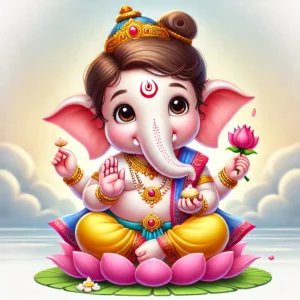
She gathered turmeric paste from her own body, mixed it with sandalwood and sacred herbs, and shaped a handsome young boy from it. She breathed life into him through her divine power. Thus, a radiant boy was born — Ganesha — loyal, strong, and pure.
Parvati smiled and said to him:
“You are my son, Ganesha. Stand guard at the entrance and do not let anyone enter while I bathe.”
Ganesha bowed and stood firmly at the door.
The Unexpected Conflict:
As fate would have it, Lord Shiva returned to Kailash just then. He moved to enter his consort’s chambers, but to his surprise, a young boy stood in his way.
Ganesha stopped him and said, “My mother is inside and has asked me not to let anyone enter.”
Shiva, unaware of who the boy was, was both surprised and amused. “Who are you to stop me? I am Shiva, the lord of this mountain and the universe!”
But Ganesha remained firm. “You may be Lord Shiva to the world, but you are a stranger to me. My mother has ordered me, and I shall obey.”
Shiva’s anger flared. He sent his attendants (the ganas) to deal with the boy, but Ganesha easily defeated them with divine strength. The gods were amazed at his power.
Finally, enraged and determined, Shiva lifted his trident (trishul) and in a moment of fury, struck off Ganesha’s head.
A Mother’s Grief:
Parvati emerged just then, only to find her beloved son lying lifeless. Her cry shook the heavens. She was heartbroken and furious.
She said to Shiva, “You have killed our son — created from my own body! I will destroy the entire creation if he is not brought back to life.”
Realizing the gravity of what he had done, Shiva was filled with remorse. The gods pleaded with Parvati to forgive, and Shiva promised:
“Your son shall live again. He will be worshipped before all other gods. I will find a new head for him and restore him to life.”
The Elephant Head:
Shiva sent his attendants to the forests and told them:
“Bring the head of the first living being you find facing north.”
They soon returned with the head of a gentle elephant calf. Shiva placed the elephant head on Ganesha’s body and brought him back to life.
Parvati’s joy knew no bounds. The gods blessed the child and showered flowers from the heavens. Lord Brahma, Lord Vishnu, and all celestial beings declared:
“From now on, Lord Ganesha shall be known as the Remover of Obstacles (Vighnaharta) and the God of Wisdom and Beginnings. His name shall be invoked before starting any new task or worship.”
The First God to be Worshipped:
Thus was born Lord Ganesha, the elephant-headed god with a child’s innocence, a warrior’s strength, and a sage’s wisdom.
Since that day, before any puja, ceremony, or important undertaking, the name of Ganapati is first invoked, with the chant:
🙏 “Shree Ganeshaya Namah” 🙏
***
📜 The Writing of the Mahabharata – A Story of Wisdom and Devotion 📜
Long ago, after the great Kurukshetra war, Sage Vyasa (also known as Ved Vyasa), the great seer and composer of epics, wanted to compose an epic poem — one that would capture the depth of dharma (righteousness), the consequences of karma (actions), and the history of the great Kuru dynasty.
This epic would be none other than the Mahabharata — the longest poem in the world, containing deep truths, stories of heroes and villains, devotion, family conflicts, and the divine message of the Bhagavad Gita.
But there was one challenge: Vyasa needed a scribe, someone intelligent and fast enough to write down the verses as he spoke them.
🕉️ Seeking a Divine Scribe 🕉️
Vyasa meditated upon the gods and prayed, “O Lord of the Universe, send me a worthy scribe who can help bring this sacred knowledge to the world.”
The gods listened, and Lord Brahma himself appeared.
Brahma said, “The one worthy of this task is none other than Lord Ganesha, the god of wisdom and intellect. Ask him, and he shall assist you.”
Vyasa meditated upon Lord Ganesha, and soon the elephant-headed deity appeared with his bright eyes, large ears, and calm presence.
Ganesha bowed and said, “O Sage Vyasa, I have come at your call. How may I serve you?”
Vyasa said, “I wish to compose the Mahabharata. I seek your help to write it as I dictate.”
The Conditions
Ganesha thought for a moment and replied, “I agree to be your scribe. But I have one condition: you must not stop while dictating. If you pause even for a moment, I will stop writing and leave.”
Vyasa, wise as he was, knew the verses would be deep and difficult. He also had a plan. He replied:
“So be it, O Ganesha. But I, too, have a condition: you must understand every verse fully before writing it.”
Ganesha smiled. The condition was fair, and so the sacred task began.
A Divine Task Begins
Vyasa would compose each verse in his mind — full of hidden meanings and philosophical depth. Because of Vyasa’s clever condition, Ganesha would have to pause to understand each verse completely before writing it down.
This gave Vyasa time to think and continue composing the next parts without ever pausing his speech.
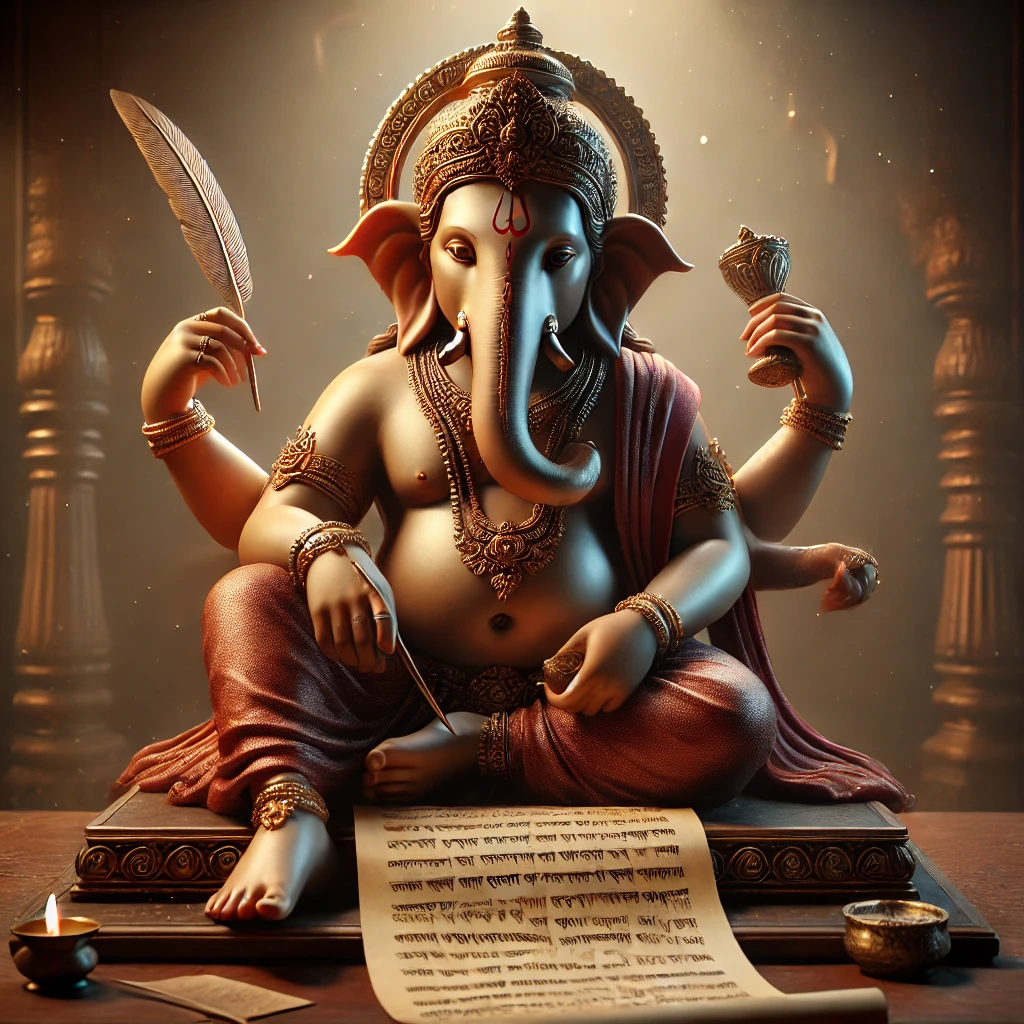
The writing of the Mahabharata took years. It was not written with pen and paper, but inscribed on palm leaves using a stylus. One day, while writing, Ganesha’s stylus broke — but the god of determination didn’t stop. He broke off one of his own tusks and used it as a pen to continue writing.
This is why Ganesha is also called Ekadanta — “the one with one tusk.”
The Result: The Great Mahabharata
After much effort and divine collaboration, the Mahabharata was complete. It came to be known as “Itihasa” – meaning “thus it happened.”
The Mahabharata contains:
The Bhagavad Gita – a sacred dialogue between Krishna and Arjuna.
The stories of Kauravas and Pandavas – two branches of the royal family.
Lessons on truth, justice, family, power, and karma.
Wisdom for all ages, wrapped in compelling stories.
Because of this divine writing, the Mahabharata became a guiding light for generations, not just in India, but across the world.
Legacy and Significance
Lord Ganesha’s intelligence and patience made the Mahabharata possible.
Sage Vyasa’s wisdom and foresight ensured that the epic was preserved in the most meaningful way.
To this day, Ganesha is worshipped before writing, reading, or beginning any important task.
And thus, the elephant-headed god and the sage created a timeless epic — not just a tale of war, but a guide to life itself.
***
🌎 How Lord Ganesha Created the River Kaveri 🌎
— A tale of divine planning and earthly blessings —
The Background
Long ago, in ancient India, the southern region was suffering from a severe drought. The lands of Tamilakam and Karnataka were dry, the crops were withering, and rivers had dried up. The sages and people prayed earnestly for water.
In the north, the sage Agastya, a great rishi blessed with immense wisdom and yogic powers, wished to help the southern land. He decided to carry sacred water from the Himalayas and create a river in the south to nourish the people.
Lord Brahma, pleased with Agastya’s intention, gave him a kamandalu (a water pot) filled with holy water. Wherever he would pour that water, a sacred river would emerge.
Sage Agastya began his long journey to the southern lands with great determination. However, the gods knew that the right moment and place for creating the river had not yet come. They needed divine intervention to guide the water’s release at the right time and place.
Who better for such a task than Lord Ganesha, the remover of obstacles?
Lord Ganesha’s Plan
Ganesha, the wise and playful elephant-headed god, took the form of a small crow. He flew across the skies and waited for the right moment. Sage Agastya, after days of journeying, stopped to rest in the cool hills of Coorg (Karnataka). Placing his kamandalu on the ground beside him, the sage closed his eyes to meditate.
At that exact moment, Ganesha-as-the-crow swooped down silently, perched on the kamandalu, and tipped it over with a flick of his beak.
The sacred water spilled from the pot and began flowing down the hills, creating a stream — and then a river.
When Agastya opened his eyes and saw the water flowing, he was startled at first. Then, through divine insight, he realized it was no ordinary crow — it was Lord Ganesha himself in disguise!
Sage Agastya bowed in reverence and said:
“O Ganesha, remover of obstacles! You have chosen the right moment and the perfect place. Let this holy water nourish the lands and bless the people.”
The Birth of the Kaveri River
And so, from that moment on, the water flowed and became the sacred Kaveri River — one of the most revered rivers of South India. It brought life to dry lands, quenched the thirst of millions, and supported agriculture, spirituality, and culture for centuries to come.
The people of Tamil Nadu, Karnataka, and Kerala came to worship the Kaveri as Kaveri Amman, the river goddess. Even today, she is honored in temples and festivals, and her waters are considered purifying.
Moral and Symbolism
Sometimes, divine intervention appears in unexpected forms — even a crow!
Lord Ganesha’s action shows that obstacles can be blessings in disguise.
The story reminds us that when actions are rooted in selflessness and dharma, nature itself supports them.
***