1



Menu
🌼 Chopda Pujan 🌼

॥ ॐ श्री परमात्मने नमः ॥
🚩 Chopda Pujan 2025 🚩
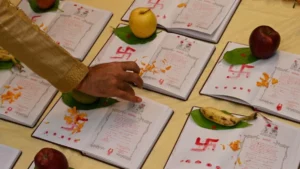
About Chopda Pujan:
The puja performed on Diwali in Gujarat and Maharashtra region of India is called Chopda Puja or Sharad Puja. The Gujarati community is renowned in the world for its entrepreneurship. Even in this modern India, Gujarati people are moving forward while maintaining the family business Indian culture. Chopda Puja is a part of religious tradition, in which businessmen worship Goddess Lakshmi on the day of Diwali and pray for a successful and profitable business year. According to the scriptures, the day of Diwali is considered the most important day to worship Goddess Lakshmi, Mother Saraswati and Lord Ganesha and get blessings, so that the person gets prosperity and success. Therefore, there is also a special practice of worshiping new ledgers on the day of Diwali.
***
🕰️ Chopda Pujans 2025 Date & Time:📅
Chopda Puja – Monday, October 20, 2025
Auspicious Choghadiya Muhurat for Diwali Chopda Puja
Afternoon Muhurat (Chara, Labha, Amrita) – 03:44 PM to 06:10 PM
Evening Muhurat (Chara) – 06:10 PM to 07:44 PM
Night Muhurat (Labha) – 10:50 PM to 12:23 AM, Oct 21
Early Morning Muhurat (Shubha, Amrita, Chara) – 01:57 AM to 06:36 AM, Oct 21
Amavasya Tithi Begins – 03:44 PM on Oct 20, 2025
Amavasya Tithi Ends – 05:54 PM on Oct 21, 2025
***
💐Significance of Chopda Pujan 💐
The spiritual significance of Chopda Pujan lies in its ability to merge material and spiritual prosperity. By worshipping the tools of their trade, businessmen and traders acknowledge the role of divine blessings in their success and express their gratitude for past gains.
The practice emphasizes that wealth should not only be accumulated but also earned through righteous means and used for the welfare of society. Chopda Pujan serves as a reminder that material wealth, while important, is a gift from the divine, and it must be respected, nurtured, and utilized ethically.
In Hindu philosophy, wealth is one of the four Purusharthas (goals of life), along with Dharma (righteousness), Kama (desires), and Moksha (liberation).
Wealth is necessary to sustain life and fulfill worldly obligations, but it must be acquired and used in alignment with Dharma. Chopda Pujan emphasizes this balance, blending the pursuit of prosperity with ethical and moral responsibilities.
***
🍀 What is Chopada Pujan: 🍀
Traditionally, ledgers are called Chopada in Gujarat. Even in this age of modernity, people of Gujarati community do calculations and additions and subtractions in ledgers only. On this day, after taking bath in the morning, they worship Goddess Lakshmi, Goddess Saraswati and God and dedicate their ledgers at their feet. To make the business progressive and prosperous, they write Swastika, Om and Shubh-Labh and use them.
***
🌻 A Fresh Financial Beginning:🌻
- For the business community, the Diwali Chopda Pujan marks the beginning of a new financial chapter.
- Old account books are closed with gratitude for the profits and successes of the past year, and new account books are opened with prayers for future prosperity.
- This practice ensures that businesses operate in a clean, honest, and transparent manner, as the rituals symbolize a financial reset.
***
🌺 Preparations for Chopda Pujan 🌺
Cleaning the House and Office: The first step is to thoroughly clean both the house and the workplace, symbolizing the removal of negativity and the welcoming of positivity and prosperity. Many people decorate their homes and offices with rangolis (traditional floor art) and light lamps to brighten the atmosphere.
Setting Up the Altar: A small altar is set up with idols or images of Lord Ganesha and Goddess Lakshmi. The new account books, calculators, pens, and other office tools are placed before the deities. The altar is decorated with flowers, particularly marigolds and roses, as they are considered auspicious.
Preparing Offerings: Offerings or “naivedyam” include a variety of sweets, fruits, dry fruits, coconuts, and flowers. Special sweets like laddoos and modaks (Lord Ganesha’s favorite) are prepared for the occasion.
***
🙏 Main Puja Ritualson chopda pujan 🙏
Ganesh Puja: The puja begins with the invocation of Lord Ganesha, the remover of obstacles. Devotees recite “Ganesh Vandana” and other mantras dedicated to Lord Ganesha to seek his blessings for a smooth and prosperous new year.
Lakshmi Puja: Next, the puja proceeds with the worship of Goddess Lakshmi. Devotees recite mantras and stotras (hymns) in praise of the goddess, seeking her blessings for wealth, prosperity, and abundance in the new financial year.
Saraswati Puja: Since Goddess Saraswati is the goddess of wisdom and knowledge, she is also worshiped during Chopda Pujan. Businessmen pray to her for insight and wisdom in managing their financial and business decisions.
Chopda Worship: The account books (Chopda) are placed in front of the deities, and sandalwood paste and kumkum are applied to them as a mark of respect and devotion. The books are also decorated with flowers and vermillion, and incense sticks are lit as part of the worship.
Reciting the Financial Pledge: As part of the Chopda Pujan rituals, businessmen recite prayers and make a vow to uphold ethical business practices. They seek divine blessings to help them make righteous financial decisions that align with moral principles.
Arati: The puja concludes with the arati, where devotees wave lamps in front of the deities and account books to symbolize the removal of darkness and the ushering in of light and prosperity.
***
🍀 Closing the Puja and Breaking the Fast: 🍀
Once the puja is completed, the new account books are opened, and the first entries are made by writing “Shubh Labh” (meaning “auspicious profit”) on the first page. This marks the official beginning of the new financial year. Families and business partners come together to share the prasad (offering) and celebrate the conclusion of Chopda Pujan with joy and enthusiasm.
***
💐 Integration with Modern Practices 💐
- In today’s digital age, the essence of Chopda Pujan has adapted to modern practices without losing its core spiritual significance.
- While traditional account books are still used in many places, many businesses now conduct their Chopda Pujan rituals using laptops, computers, and accounting software. These modern tools are sanctified during the puja in the same manner as physical ledgers.
- The inclusion of digital tools reflects the evolving nature of businesses and industries while maintaining the timeless values of spirituality, devotion, and ethical conduct.
- The rituals have embraced the technological advancements of the modern world, showing that spirituality and business practices can evolve together.
***
🍀Mantras of Chopra Pujan:🍀
Ganesh Vandana
श्री गणेशाय नमः ।
Shri Ganeshay Namah.
Lakshmi Vandana:
ॐ श्री लक्ष्मी नमः।
Om Shri Lakshmi Namah.
Self purification mantra:
ॐ अपवित्रः पवित्रो वा सर्वावस्थां गतोऽपि वा। यः स्मरेत् पुण्डरीकाक्षं स बाह्याभ्यन्तरः शुचिः॥
Om apavitrah pavitro va sarvavasthaam gato’pi va. Yah smret pundarikaksham sa bahyabhyaantarah shuchih.
Lakshmi Mantra:
ॐ श्री महालक्ष्म्यै च विद्महे, विष्णु पत्न्यै च धीमहि, तन्नौ लक्ष्मी प्रचोदयात॥
Om Shri Mahalakshmyai cha Vidmahe, Vishnu Patnyai cha Dhimahi, Tannau Lakshmi Prachodayat.
Before starting the puja
ॐ केशवाय नमः।
Om Keshavaya Namah.
ॐ नारायणाय नमः।
Om Narayanay Namah.
ॐ माधवाय नमः।
Om Madhavaya Namah.
ॐ हृषीकेशाय नमः”।
Om Hrishikeshaya Namah.
***
💐Conclusion 💐
The ritual of Chopda Pujan reminds people of the deep-rooted customs that guide the Indian business community as the festival of Diwali draws near. By asking for God’s blessings and accepting lucky times, business owners start the path to a successful fiscal year. In the ritual of Chopda Puja, custom and modernity come together to show how Indian culture has stood the test of time. May your business grow and thrive in the coming year as you get ready for this holy event. May the gods bless you and guide you. It’s not just about keeping records; Chopda Puja is also about honouring traditions, strengthening family bonds, and raising hope. If you have reasonable goals and God’s blessings, have a wonderful new year!
***