1



Menu
🌼 Vat Savitri Vrat 🌼
॥ ॐ श्री परमात्मने नमः ॥
🚩 Vat Savitri Vrat 2025 🚩

About Vat Savitri Vrat:
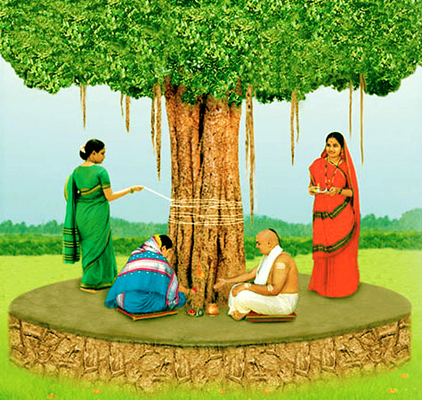
Vat Savitri Vrat, a Hindu holiday, is a special occasion for married women. This ceremony is also known as Vat Amavasya. This holiday is observed by women in relationships. At this occasion, the wedded woman wraps a sacred thread around a banyan tree to make a sign of her love for her husband. The incident is based on the story of Savitri and Satyavan. In Indian tradition, this fast, as it is portrayed in the Mahabharata, has come to symbolize aspirational femininity.
This fact is the subject of a lot of debate. Fasting on the day of the full moon in Shukla Paksha of the Jyeshtha month is forbidden by the Skanda Purana and the Bhavishya Purana; however, Nirnayamrita and other sources dispute this.
Despite the different dates, the objective of this festival is the same. According to the view held by many women, this fast should be performed between Trayodashi and Poornima in the Shukla Paksha and between Trayodashi and Amavasya in the Jyeshtha month. On full moons, most Lord Vishnu’s followers observe this fast.
“Vat Savitri fast” considers “Vat” and “Savitri” to be especially important. The banyan views the vat as being identical to the tree. The banyan tree has great significance in Hinduism. The Puranas explicitly state that the vat is home to Brahma, Vishnu, and Mahesh. In Indian culture, Savitri is regarded as a historical figure. Saraswati and Ved Mata Gayatri are also known as Savitri.
***
🕰️Vat Savitri Vrat 2025 Date & Time:📅
Vata Savitri Amavasya – Monday, May 26, 2025
Vat Savitri Purnima Vrat on Tuesday, June 10, 2025
Amavasya Tithi Begins – 12:11 on May 26, 2025
Amavasya Tithi Ends – 08:31 on May 27, 2025
***
💐Vat Savitri Vrat 💐
According to the Amanta and Purnimanta lunar calendars, the majority of the festivities occur on the same day. States in North India, including Uttar Pradesh, Madhya Pradesh, Bihar, Punjab, and Haryana, observe the Purnimanta calendar. The Amanta lunar calendar is typically observed in the remaining states.
Vat Savitri Vrat, however, might be seen as an anomaly. In the Purnimanta calendar, Jyeshtha Amavasya, which falls on Shani Jayanti, is when Vat Savitri Vrat is observed. During Jyeshtha Purnima, the Amanta calendar observes Vat Savitri Vrat, also known as Vat Purnima Vrat.
As a result, married women in southern Indian states like Maharashtra and Gujarat celebrate Vat Savitri Vrat 15 days (about two weeks) later than women in northern India. But in both calendars, the story of keeping the fast is the same.
Legend has it that the magnificent Savitri deceived the lord of death, Lord Yama, and forced Him to give her spouse Satyawan back his life. Therefore, Married ladies observe Vat Savitri Vrat for their husbands’ longevity and well-being.
***
🍀Rituals of Vat Savitri Vrat: 🍀
- Before dawn, women bathe in a sacred mixture of til (sesame seeds) and amla (Indian gooseberry) and change into fresh garments. They promise a nirjala (no water intake) fast while wearing bangles and applying vermillion, which are accessories associated with married women.
The roots of the Vat (Banyan) tree are consumed by devotees, and if they are fasting for three days in a row, they also drink water.
They wrap a sacred thread in red or yellow around the Vat tree’s trunk after praying to it.
In addition to doing Parikrama or making circuits of the banyan tree while saying prayers, women often present the tree with rice, flowers, and water.
To carry out the rites in a similar manner in the absence of a banyan tree, devotees can use turmeric or sandalwood paste to make an image of the tree on a wooden base.
On the day of Vat Savitri, devotees must also prepare sacred cuisine and special delicacies. Prasad is given to every family member once puja is over.
In their homes, women also look to the elderly for blessings.
The poor should get clothing, food, cash, and other necessities from devotees.
***
🌻 Significance Of Vat Savitri Vrat🌻
Devi Savitri, who compelled the Lord of Death (Yama Raj) to grant her departed spouse life, is honored at the event. On this day, women pray to a banyan tree. People celebrate twice a year in accordance with the Hindu lunar calendar.
The Vat (Banyan) tree represents the “Trimurtis,” or Lords Vishnu, Brahma, and Shiva, in Hindu mythology. It is said that those who worship a banyan tree are lucky. The importance of the fast is covered in a variety of texts and Puranas, including the Skanda Purana, Bhavishyottara Purana, Mahabharata, etc.
Hindu married women ask for their husbands’ prosperity, health, and longevity by fasting and performing Vat Savitri rites. To demonstrate her devotion to and sincere love for her husband, a married woman follows Vat Savitri Vrat.
***
🍁Vat Savitri Vrat Puja Vidhi🍁
- Start the Vat Savitri Vrat on Trayodashi as a married Hindu woman.
- Apply amla (Indian gooseberry) and sesame paste on the first day of the fast.
- During Vat Savitri Vrat, eat the banyan tree’s roots.
- For the next three days, worship a banyan tree that has been painted with turmeric or sandalwood paste on a piece of wood or a plate.
- Get up early and take a ceremonial wash on the fourth day of the fast.
- Place the idols of Yamraj and Satyavan-Savitri at the banyan tree.
- On your forehead, apply vermilion and wear a bridal gown and jewelry.
- Offer the banyan tree your prayers. Additionally, offer prayers to Savitri, who is deserving of reverence.
- Apply vermillion all around the tree and wrap sacred strands in red or yellow around the tree’s trunk.
- Chant prayers as you round the banyan tree seven times.
- You can pray for a good husband for the future while wearing a yellow sari if you are still single.
- On Purnima, break your fast with prasad, which consists of banana, lemon, jackfruit, mango, and wet pulses.
***
💐Puja materials required for Vat Savitri vrat💐
- A vase full of water
- Raw yarn
- Maroon thread
- Roli, sindoor, Akshat
- Sweets
- Flowers, incense sticks, dhoop
- Bamboo basket and a bamboo fan
- Soaked chickpeas
***
🍀 Mantras of Vat Savitri:🍀
अवैधव्यं च सौभाग्यं देहि त्वं मम सुव्रते।
पुत्रान् पौत्रांश्च सौख्यं च गृहाणार्घ्यं नमोऽस्तुते।।
यथा शाखाप्रशाखाभिर्वृद्धोऽसि त्वं महीतले।
तथा पुत्रैश्च पौत्रैश्च सम्पन्नं कुरु मा सदा।।
avaidhvyam cha saubhagyam dehi tvam mam suvrate.
putran pautranshch saukhyam cha gruhanadhry namostute.
Yatha shakhaprashakhabhivruddhyodso tvan mahitale.
tatha putraishch pautraishch sampanam kuru ma sada.
***
💐Conclusion 💐
This concludes the discussion of this holy vrat, which is observed by worshiping the banyan tree in a way that is considered auspicious. The vrat brings to mind Savitri’s protest, in which she defied fate and relieved her husband of his suffering.
***